14 minute read
- Practices adopted without changing the organisation's theory of the business are only on loan and will evaporate when the person carrying them leaves. see why — jump to the section that argues this
- The shopfront story is a case study in decision latency, where the market moved faster than the organisation’s governance. see why — jump to the section that argues this
- AI does not fix an operating model; it stress-tests it by strengthening learning in adaptive systems and accelerating waste in predictive ones. see why — jump to the section that argues this
- Build measures, decision rights, and improvement loops into the system so practices and results survive the departure of the people who created them.
- Use AI to generate and feed evidence into faster learning loops at the point of decision, not merely to automate more output from your existing operating model.
- Change your organisation’s theory of the business before scaling borrowed practices, or accept that their achievements are only on loan and will regress when their sponsors leave.
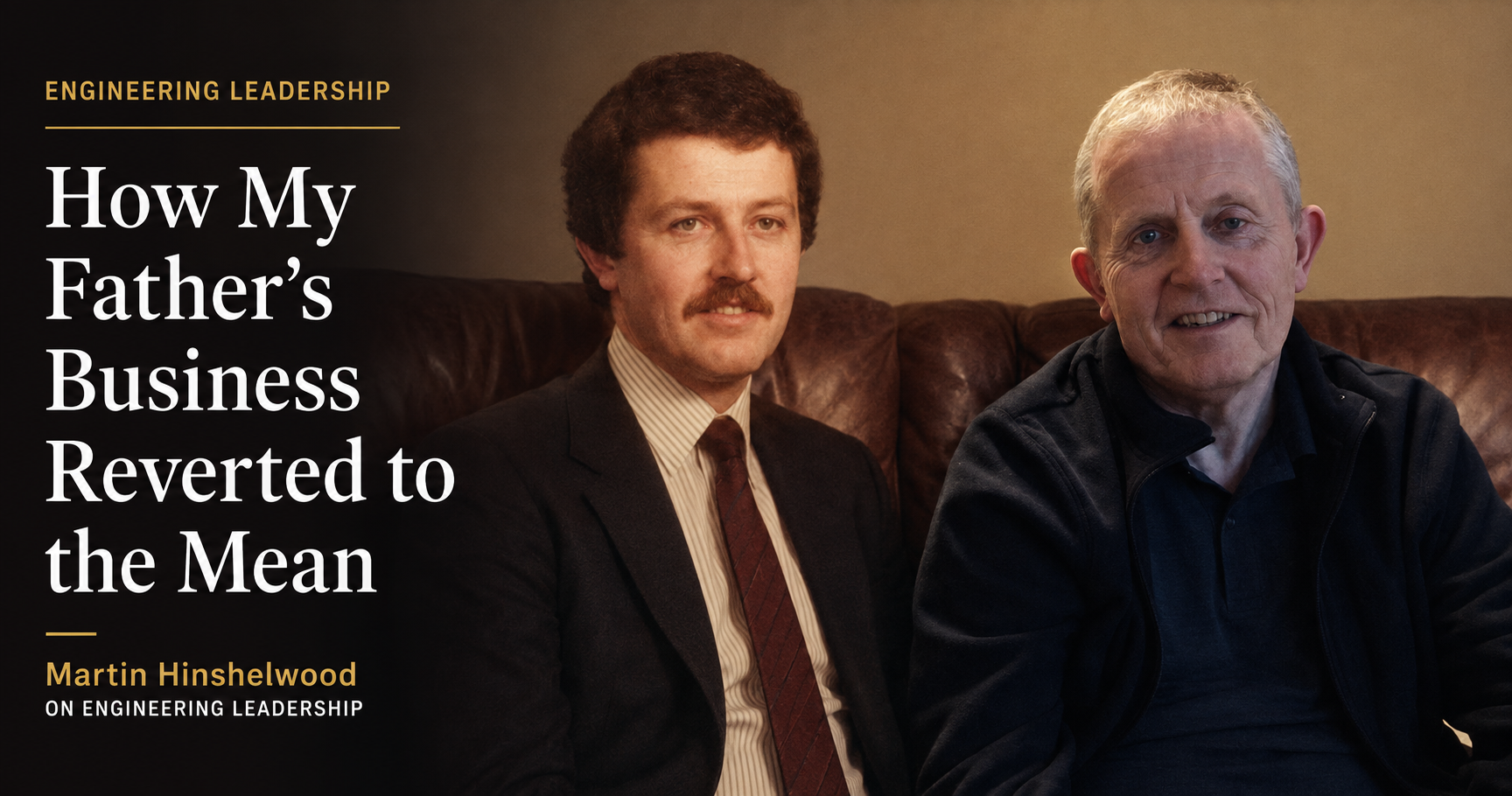
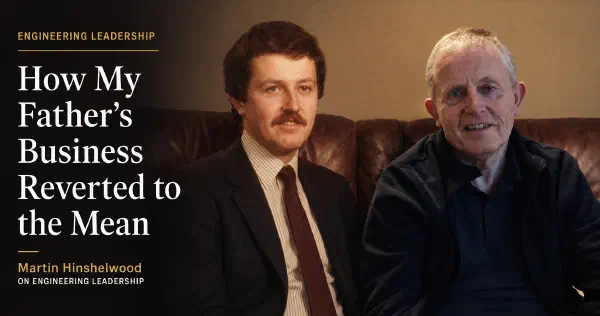
My father died eight years ago today.
Twelve years ago I wrote about him: What my father taught me about Evidence-based Management (34 years before it was invented!). One sentence in that article mattered more than I understood at the time: “Three months after he left they were making a loss again.” I wrote it as a footnote to a success story. It was actually the opening line of a different story: one that took another decade to finish, and one I can only tell now because the ending has arrived.
This is that story. It is about a man who engineered an organisation decades before anyone would have called it that, and about what happens to everything he built when the organisation around it never changes its own theory of the business. There is a dry name for the pattern (operating-model regression), but the story doesn’t need the name. It needs the ending, which has now arrived.
Before I start: this is a family story, told from memory, about events that happened before and shortly after I was born. I have verified what can be verified (the corporate history, the industry numbers) and I flag below what rests on my family’s account alone. Some details may be wrong. The shape of it is not.
A shopfront in Shawlands
Around 1980 my father, John Hinshelwood, was an apprentice surveyor at a firm in the west end of Glasgow. The firm had been considering expansion and held an option on a shopfront in Shawlands, on Glasgow’s south side. The leadership team went off to a golf retreat, and in 1980 that meant they were uncontactable. While they were away, the shopfront’s owner called: he had another buyer, and he needed a decision now.
My father stepped up and signed the ten-year lease.
When the leadership came back, they decided not to proceed, and they would not stand behind the commitment made in their name. He was left with a ten-year lease on a shopfront, a new baby (me), and no support. So he did the only thing the situation allowed: he opened “Hinshelwood & Co.” in that shopfront and became his own employer.
I have told that story for years as family history. It took me embarrassingly long to see that it is also a case study, and that its subject is decision latency. The market moved faster than the governance. There was a real buyer and a real deadline, and the empowered person on the ground made the call. The organisation’s response to that adaptive decision was to punish it. Whatever an organisation’s values poster says, its true operating model is revealed by what it does to the person who made the right call without permission.
Be the agent. Show the house.
Hinshelwood & Co. did well, and my father became known in Glasgow for how he ran it. He had been apprenticed as a surveyor, a surveyor in the Scottish sense: the one who walks a property and tells you what it is actually worth. The lease ended the apprenticeship, but the way of seeing stayed, and he ran the business the way a surveyor runs a survey: by measurement. His operating theory was simple enough to fit in a sentence: an estate agent’s job is to be the agent and show the house.
He was a workaholic, so almost every childhood memory I have of him is a work memory, and most of them are the same memory: standing in a house he was showing, listening to him answer whatever the buyers asked. The history of the house. The street. The schools, the transport, where the area was heading. In all those years I never once heard him say “I don’t know”, or “I’d need to check”. He just knew. Not because he had a gift, but because he had done the work of knowing. He treated the buyer’s questions as the evidence that mattered and organised the whole business around being able to answer them.
None of this had a name in 1980. Today I’d say he was doing to an organisation what engineers do to anything: using rules of thumb he trusted only as long as the evidence backed them, making the best change he could in a situation nobody fully understood, with the resources he actually had. At the start, those were a ten-year lease, a newborn, and nothing else. He built relationships with every competitor in the city, sold the business years later to Bell Ingram, and rose quickly to managing director.
The insurers buy the high street
Then the insurance industry arrived, and this is where my family’s story joins a documented one.
In the late 1980s Britain’s financial institutions convinced themselves that estate agency was a distribution channel for mortgages and insurance, and bought the high street at extraordinary speed. Royal Insurance controlled 772 branches by October 1988. Prudential peaked at 807 that same autumn (briefly the biggest agency network in the country) and had planned for a thousand. Lloyds built Black Horse Agencies; General Accident built GA Property Services. Within three years the retreat had begun: Prudential withdrew from estate agency entirely around 1990–91 at an estimated loss of £400 million, and the others followed their own versions of the same curve: sold off, rebranded, or quietly run down.
It is worth being precise about why, because “the housing market crashed” is only the trigger, not the cause. Insurance is the purest predictive business there is: actuarial, model-driven, optimised for the average case over long horizons. Estate agency, done the way my father did it, is the opposite: adaptive, local, built on responding to this buyer, this street, this week. The insurers bought thousands of small adaptive businesses and ran them on a predictive theory of the business. The theory lost, industry-wide, and the losses ran to hundreds of millions.
My father was inside that machine. Bell Ingram’s residential arm was, as I understand it, part of Royal’s foray into estate agency, and he became managing director for Scotland, the north of England and Ireland. When a rebrand came, he was (again, as the family tells it) instrumental in choosing the name Allen & Harris, for the most evidence-based of reasons: it fit legibly on the fascia at a readable size. “Hinshelwood” was too long; the letters would have been too small. The company’s own history page today traces the name to a first branch in Didcot in 1966, and both things can be true: the name may well have existed in the acquired portfolio; what my family remembers is that he put it on high streets across Scotland, and why. I note the discrepancy rather than resolve it. A sub-brand leaves no Companies House trail, and the people who could settle it are gone.
What is not in dispute is what he did with it: Allen & Harris became the leading estate agency brand in its territory and it was profitable.
He read shopfronts the way he read houses. He was so good at judging where an estate agency window should sit on a street that he bought the best-placed properties himself and leased them back to his employer. The insurer that ran his business on actuarial models paid him rent, every month, for understanding the ground truth of the high street better than its models did. And still its restrictions dismayed him constantly.
The hostile takeover
He was dismayed enough, eventually, to attempt a takeover of that part of the business. I now read it as an attempt to win the authority to fix the whole system rather than merely his corner of it. Within his own span he could design how things worked; above it, he could only ever be the man holding a badly designed system together by hand. It failed, and he got three months of garden leave for trying.
In those three months, the business went from profit to loss.
They asked him back at double the salary, and he made it profitable again.
I know of no cleaner natural experiment in management. Same market, same branches, same people, same brand, same parent company: the only variable removed was one person, and the system reverted in a quarter. The capability had never left the building; the maintenance had. When I wrote the 2014 article I used the same fact about a later departure as a proof of how valuable the practices were. I now read it the other way around: it was proof that the practices had never been installed in the system at all. They lived in him. The parent company tolerated the results without ever understanding the method, which meant the method had exactly one point of failure.
W. Edwards Deming is credited with the observation that a bad system will beat a good person every time. The garden-leave quarter is what that looks like with the confounding variables stripped out.
The reversion completes
The 2014 article ended with him leaving and the business slipping back into loss. Here is the rest, which is now a matter of public record.
Royal and Sun Alliance merged in 1996. Their estate agency operation (twelve brands, Allen & Harris among them) was bundled into a vehicle called Sequence, and in October 2003 the insurer gave up on estate agency altogether and sold Sequence to Connells. The corporate entity that had carried the ambition, incorporated in 1986 as Royal Life Estates and later renamed Royal & Sun Alliance Property Services, was finally dissolved in December 2025, having long since become an empty shell.
Allen & Harris still trades. It is one of twelve near-identical brands in the Connells portfolio, distinguished from its siblings by little more than the name on the sign. When I was young that name was everywhere: a For Sale board on every street, and on the high street a shopfront that was always well-sited and never shabby (his doing, literally, since he picked the sites). Now both are a rare sight, and not always a proud one. That is my observation from the pavement, not a market-share statistic; but boards on streets and windows on corners were exactly the leading indicators he managed: placement, presence, condition. By his measures the decline is not subtle.
There is a pattern here, and it has a mechanism, not a mood. An adaptive way of working was imposed, by force of personality and sustained effort, on top of a predictive theory of the business. The parent never changed the theory; it merely hosted the results. And what nobody maintains, decays: the refactoring was him, the authority was him, the hygiene was him. So when the force left, through attrition, retirement, and death, the understanding left with it, because it had never been transferred into the system: no institutional memory of why the practices worked, nobody left who knew what the sign placement was for. The organisation did not collapse. It did something quieter and more common: it reverted to the mean of its parent’s operating model, one departed person at a time.
If you have watched something you built decay after its sponsor moved on, you have watched the same film. Everything that lives in a person instead of the system has already scheduled its own regression. An engineered thing that nobody maintains does what all unmaintained things do: it reverts to the mean of its environment.
The system reverted. He never did. Retirement didn’t stop him: he built one more business, flipping properties, the craft he had been apprenticed to at the very start reduced to its purest form. Walk the house, know what it is actually worth, act before anyone else has finished checking. The parent company could take the brand and the branches; the method walked out the door with him and kept working. It took multiple sclerosis, years later, to finally stop him: the walking first, then the rest. Nothing in business ever managed it.
What the evidence asks of the system
Evidence-Based Management, as Scrum.org’s guide now frames it, asks an organisation to look at four things: the value customers get today, the value still unrealised, how fast the organisation can deliver and learn, and its ability to innovate. My father’s business maps onto all four without translation: the answered question in the viewing room was current value; the market seen from the pavement was unrealised value; the signed lease was time-to-market; the freedom to change how the branch worked was ability to innovate.
But the lesson of his career is not that the practices work. I knew that in 2014. The lesson is that practices adopted without a change in the organisation’s theory of the business are on loan, and the loan gets called the day the person carrying them leaves. If the measures, the decision rights and the improvement loop are not built into the system, if management cannot say why the thing works, only that it does, then every result the practices produce is one departure away from evaporating.
AI runs the same experiment faster
Which brings me to now, because I think the 2020s are re-running the 1980s insurance experiment at machine speed. AI does not fix an operating model; it stress-tests it: it strengthens learning in adaptive systems and accelerates the waste in predictive ones.
Evidence has never been cheaper. The instrumentation my father built by walking streets and answering questions is available to any organisation for the cost of an API call: what customers do, what they ask, where they hesitate, what they value. Gut-feel management is less excusable than it has ever been. And yet most organisations are using AI to produce more output, not more evidence. They are automating the artefacts of their existing operating model.
And AI amplifies whichever theory of the business you already have. An adaptive organisation gets faster learning loops: cheaper experiments, shorter decision latency, evidence at the point of decision. A predictive organisation gets its wrong answers faster and at greater scale, delivered with more confidence than any regional director ever mustered. The technology does not care which one you are. It is an amplifier, not a corrective.
The golf-retreat story is quaint now: leadership uncontactable for a week seems impossible. But the constraint it exposed has not moved: the market’s clock against the organisation’s clock. Markets now shift in the time it used to take to convene the meeting. If your governance still requires the retreat to end before the lease can be signed, AI will not save you; it will simply make the buyer who got there first faster too.
And the heart of it has not moved either. An estate agent who merely shows the house is a search engine with keys. What my father sold was the answered question: the accumulated, verified, local evidence that no listing could carry. Every knowledge business now faces the same fork he stood at: be the agent, or be disintermediated by something that shows the house for free.
I think my dad would have loved these tools. AI is the perfect sidekick for an agent who intends to answer every question. He would have used it to know more streets, more histories, more schools, faster than any competitor could. What he would never have done is let it do the knowing for him. A sidekick amplifies the agent; it does not replace the agency. I would have loved to watch him use it.
Subscribe to Martin's articles
Writing since 2001
Articles, usually weekly on Mondays. One click to leave.
The sign still fits
Allen & Harris has a branch in Shawlands today. It stands across the road from the shopfront where a leadership team’s absence handed an apprentice surveyor a ten-year lease and a career.
The sign fits the fascia at a readable size, exactly as he intended. I do not suppose anyone behind the glass knows why the business it belongs to once worked, or who made it work, or what was lost when the understanding walked out of the system one person at a time.
Systems outlive people. Build the evidence into the system, transfer the why along with the what, or accept that everything your best people achieve is on loan. My father engineered his company; nobody engineered the company above him, and that is the system that won. He proved the practices work. The forty years since have proved that proving it is not enough. Eight years on, that is the lesson I’d most like to give back to him.
Read 171 times. Enjoyed it? One click, no account.
Questions this answers
What happens to a successful business or set of practices when they depend on one person instead of being built into the system?
When a business’s way of working lives primarily in one person rather than in the organisation’s operating model, the results are effectively on loan: performance improves while that person is present but regresses once they leave. Without building the measures, decision rights, and improvement loops into the system—and without management understanding why the practices work—capability decays over time and the organisation quietly reverts to its prior norm.
How does AI affect adaptive versus predictive operating models in organisations?
AI amplifies whichever operating model an organisation already has: in adaptive systems it strengthens learning by making experiments cheaper, shortening decision latency, and bringing evidence closer to the point of decision, while in predictive systems it accelerates the production and scaling of wrong answers. Rather than correcting a flawed theory of the business, AI stress-tests it at high speed, making adaptive organisations more responsive and predictive ones more efficiently wrong.
Smart Classifications
Each classification [Concepts, Categories, & Tags] was assigned using AI-powered semantic analysis and scored across relevance, depth, and alignment. Final decisions? Still human. Always traceable. Hover to see how it applies.